Software Factories: The New Bottleneck Is Human Judgement
Software factories make building cheap and wrong decisions expensive. Deciding what to build, what counts as done and who answers for what ships stays with people.
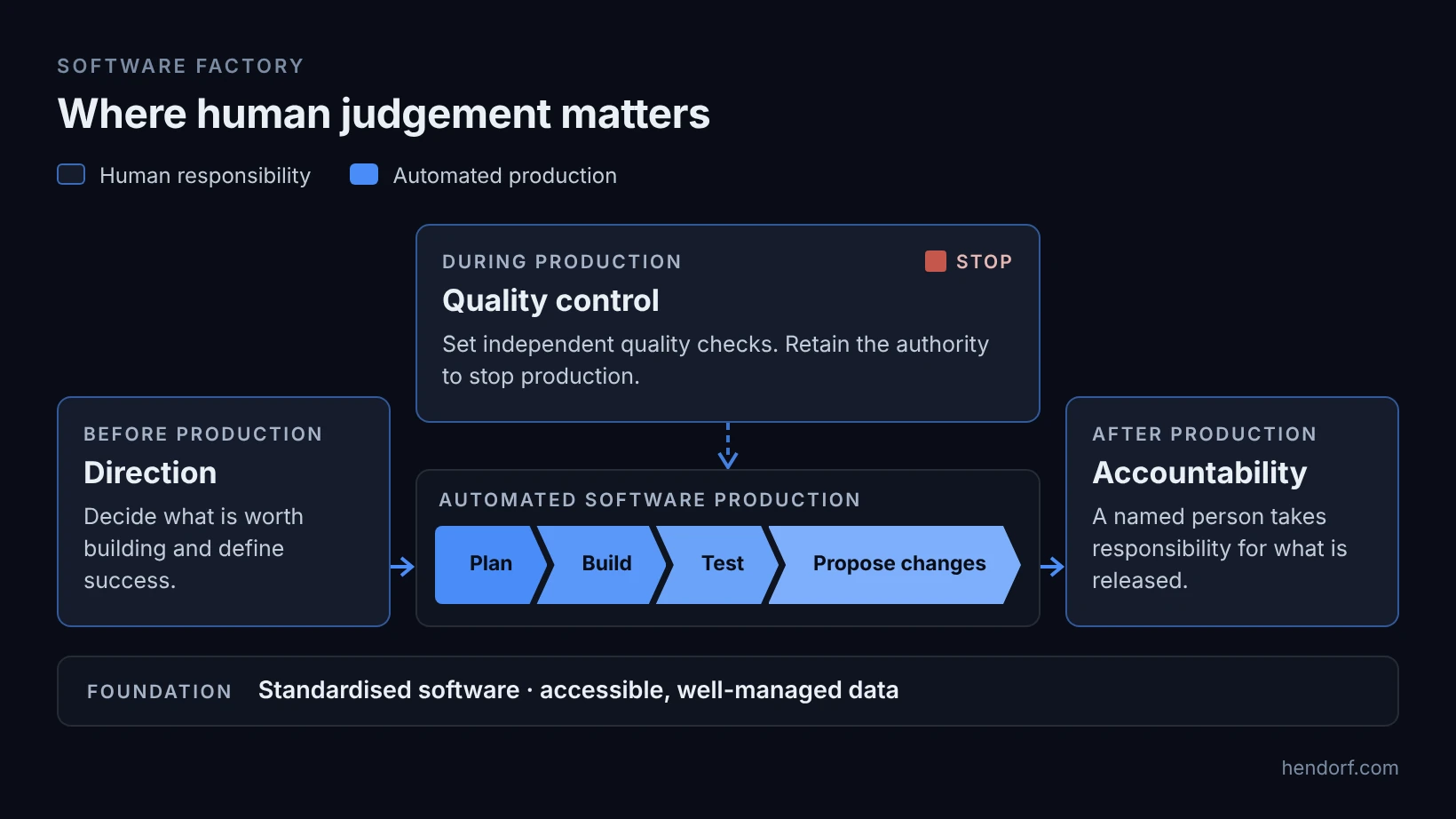
In January 2026, the AI "software factory" was not a topic. By November it is a major one, though it is an old idea. The leading question is plain: can several probability machines working together produce something productive and reliable, to what extent, and at what cost? My answer: yes, for well-specified work with checks the agents cannot influence, at a cost that has to be planned. The decisive cost is human judgement, and a factory needs it in three places: before the line, to decide what is worth building; on the line, to define the checks and stop it when needed; and after the line, to answer for what ships.
At a Glance
- In a software factory, agents start and carry out parts of the work, from a ticket or an alert to a reviewable change.
- Several agents working together deliver reliable results where independent checks cover what matters. Quality beyond tests stays with people.
- Factories flourish only on standardised software and accessible, well-managed data. Once verification capacity is full, more agents only lengthen the queue.
- Name a person for each position before adding agent capacity: intent before the line, checks and the authority to stop on it, accountability after it.
What a Software Factory Is
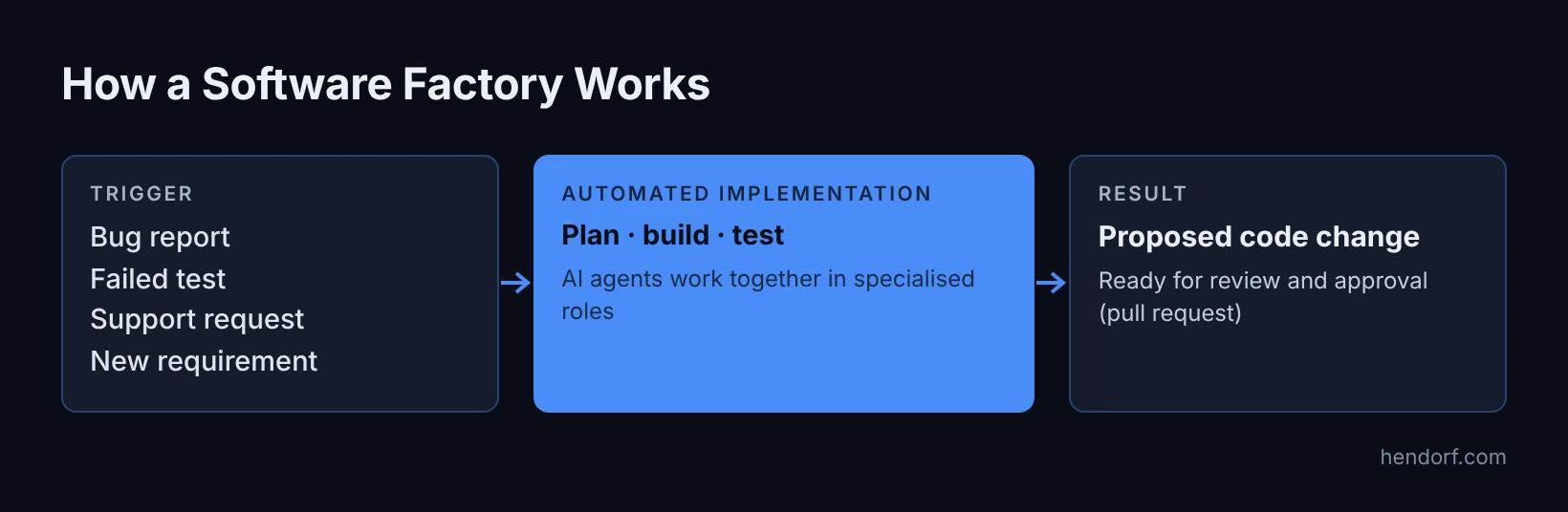
Behind the many definitions sits a common core: people no longer start all of the work themselves. A bug report, a failed check or a support ticket starts an agent run, and agents plan, write, test and propose the change as a pull request, a code change awaiting approval.
The agents in such a factory are probability machines: language models built on aggregated human intelligence, the code and text written by millions of people. A factory chains several of them, each in its own role, and lets them work through the lifecycle with as little human initiation as the organisation allows.
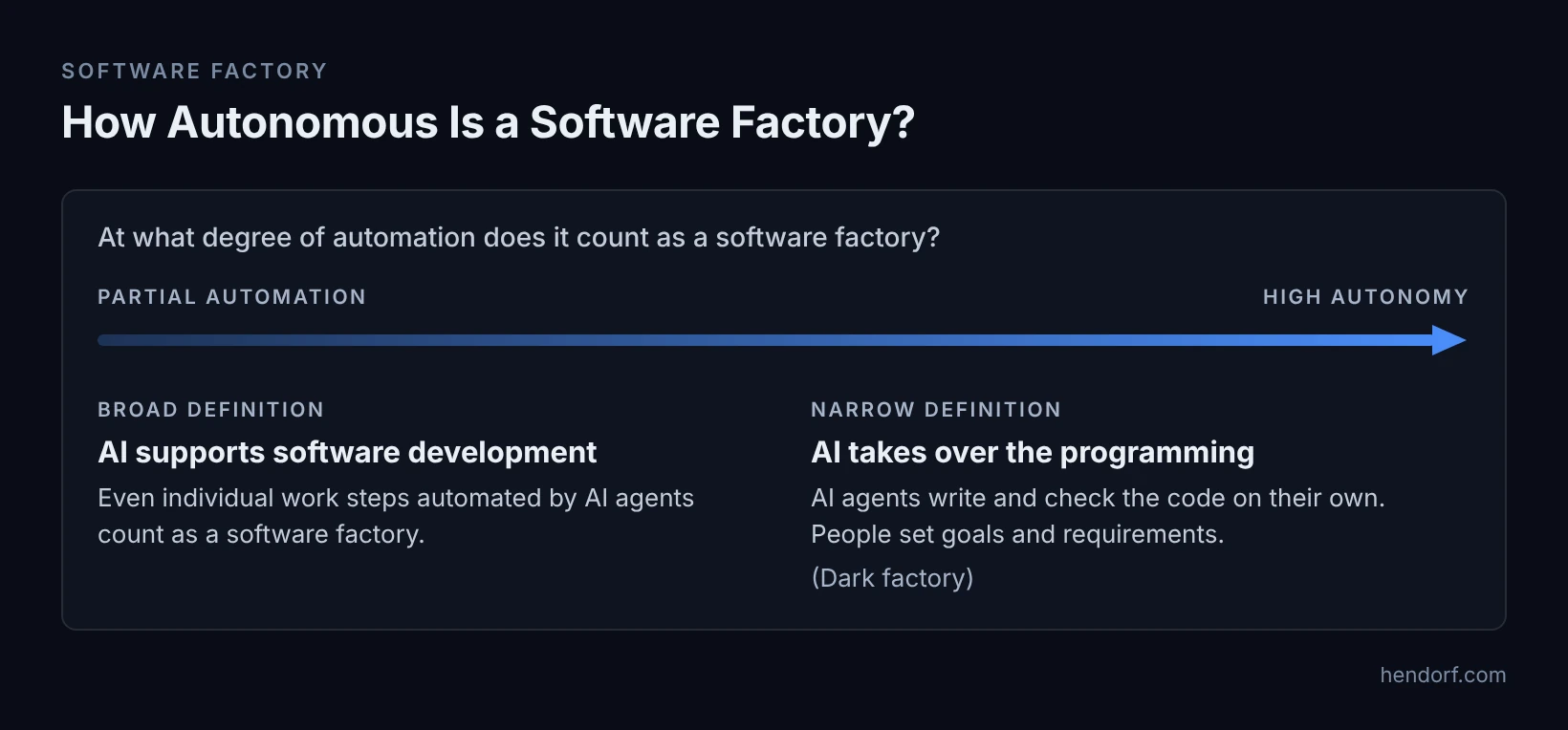
The definitions differ in how little that is. At the narrow end sits the "dark factory": StrongDM published its approach in February 2026 with a charter of two rules. Code must not be written by humans, and code must not be reviewed by humans. At the broad end, any agent loop across the lifecycle counts, up to an "everything factory" that extends to sales and support. Much of this definition work comes from companies that sell parts of the factory, so let me weight it accordingly.
The term dates from 1968, when Bob Bemer at General Electric proposed a "software factory" of standardised tools and historical data. Hitachi, Toshiba and others ran such factories in the 1970s and 1980s. Agents in different roles arrived within months of the ChatGPT moment: in 2023, ChatDev and MetaGPT staffed virtual software companies with agent CEOs, architects and testers, and AutoGPT promised agents that work through tasks on their own. Most came and went, stuck in loops, inventing results and burning tokens. What has changed since is the quality of the models and especially of the checks ("harness") around them. That makes the idea worth a serious look this time, if it turns into a productive concept.
Where the People Go
Addy Osmani, for years a reliable voice for real progress amid the hype, long at Google and now at Anthropic, has argued that human judgement does not leave the software factory but relocates. I agree. The organisational question is where it relocates to and who answers for it. I see three positions, and each needs a named person.
Before the Line: Deciding What Is Worth Building
A factory of probability machines produces the likely result. Whether the likely result is right for this product, this customer and this risk is a judgement no amount of aggregated human intelligence makes on its own. Someone has to decide what enters the factory and what "done" means.
On the Line: Defining the Checks, With the Authority to Stop
People check the agent's evidence instead of every line: tests, screenshots, recordings of the feature in use. That only works if someone designs the evaluations that produce the evidence, out of the agents' reach. Without them, quality can erode unnoticed.
Manufacturing learned this long ago. One of the two pillars of Toyota's production system is jidoka, which Toyota translates as "automation with a human touch": a machine that detects an abnormality stops, and people decide what happens next.
After the Line: Answering for What Ships
Every change needs an owner who is a person. Whoever starts an agent run stays accountable for its result, and that has to be settled before something goes wrong. Often it is not. In a survey of 383 developers I co-led for the Python Software Association Germany, 68 percent name reviewing AI output as a new task, and 71 percent say it is not explicitly defined who answers for a defect an AI caused. That gap is what I call control debt. Customers, auditors and supervisors will keep asking who approved a change.
Expectation and Reality
Most expectations come from the factory metaphor.
Expectation: A Volume Machine → Reality: The Bottleneck Moves
Anthropic, itself a seller of agent tooling, reports that its daily merged code changes rose from about 2,500 in May 2026 to more than 30,000 in September, and that the bottleneck has moved to infrastructure built for human pace: source control, builds and automated testing. The next constraint is harder to see: keeping a product coherent as a whole.
Expectation: Plug In Agents and the Factory Runs → Reality: Your Process Is the Factory
A sandbox in which an agent turns a request into a code change is quick to build, and on its own adds little to what developers already achieve with agents on their laptops. One person orchestrating twenty agents can be productive, but process, measurement and control stay personal. The value comes when an organisation encodes its own process into a shared system: how work is planned, how tasks depend on each other, who reviews and who signs off, with every agent run traceable to the person, project and team that started it.
Expectation: Dark Factory → Reality: Mostly Lit, With Dark Corners
Osmani distinguishes light factories, with people in the loop, from dark ones. I expect most teams to run lit factories with dark corners, for two reasons. Lights-out works where a check the agent cannot influence decides whether a result is right, and only as far as that check covers what matters. Coding models are trained in part on rewards for making tests pass, and tests catch wrong behaviour, not a codebase that grows harder to modify with every update. The long-term evidence is still thin, but run a codebase lights-out for months, and I expect problems to accumulate in code nobody has read, including problems the agents cannot solve. A dark factory also needs the intent fixed up front, and good software rarely comes about that way: requirements emerge along the way.
In 2018, after over-automating the Model 3 line, Elon Musk called excessive automation at Tesla his mistake and concluded that "humans are underrated".
To What Extent, and at What Cost
Whether a factory pays off depends less on the industry than on the kind of work and the foundations it runs on.
| Pays off | Pays off less |
|---|---|
| High-volume, repetitive changes: migrations, dependency updates, removing old feature switches | One-off product decisions with open requirements |
| Results a machine can check: tests, type checks, comparison with a design | Results only a person can judge: product fit, user experience, architecture |
| Solid foundations: reproducible builds, good test coverage, documented systems | Legacy code that runs on tacit knowledge and thin test coverage |
| Changes whose effects stay contained | Changes where one fault can do wide damage and nothing checks independently |
| Enough change volume to carry setup and running costs | Small teams with little change volume |
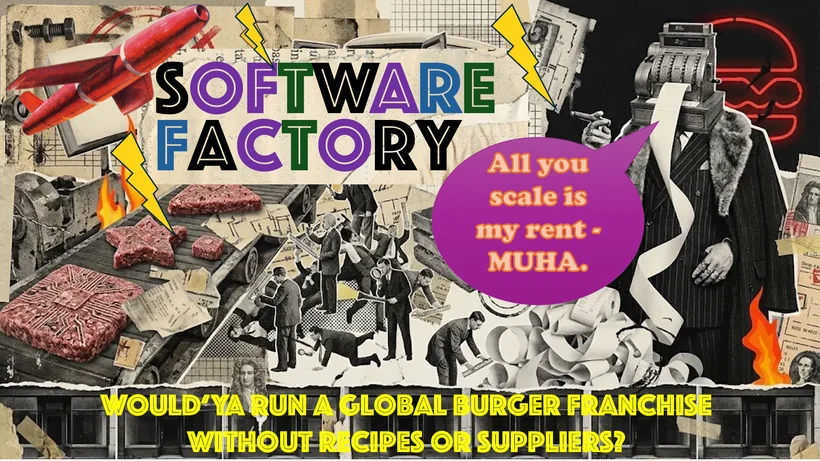
The ingredients that decide most are the ones scale and automation make easy to overlook: standardisation and data quality. Software factories flourish only on well-standardised software and on data that is accessible and well managed. Standardisation is the prerequisite, and open source is the most reliable way I know to get there. The models learned much of their craft from aggregated human intelligence, a large part of it open-source code, so mature open-source projects and open standards are what they reproduce best. Where conventions are consistent, a factory reproduces them reliably. Where every team works its own way and data sits in silos, it multiplies the inconsistency. A software factory without standards and clean data is a global burger franchise without recipes or suppliers. All you scale is the rent.
Uber's figures rest on exactly that groundwork: six years of consolidated code repositories and a common build system. More than 70 percent of its pull requests are now attributed to local or cloud agents.
The visible cost is tokens, paid model usage: StrongDM's stated benchmark is at least $1,000 per engineer per day, a six-figure sum per engineer over a working year. The less visible cost decides. The marginal cost of software moves from writing code to specifying, checking and deciding. More agent capacity adds value only as long as verification keeps up; beyond that point it lengthens the queue of unchecked changes. So test infrastructure, evaluations and standardisation come before more agents. Savings in writing code should not all be booked as lower headcount, because part of them has to pay for verification and for finding out what is worth building. Measure lead time to customer value, defect rate and time to recovery. A business case that counts pull requests is unfinished.
For Decision-Makers, This Means
First: Decide Where People Stand Before You Decide How Dark It Gets
At every step of the lifecycle, name who sets the intent, defines the check, can stop the line and answers for the result. Darken only the corners where a check the agent cannot influence verifies the outcome. I see this as a leadership task before a tooling task: someone has to hold intent, checks and accountability together, from the executive floor to the pipeline.
Second: Budget the Judgement Work
Specifying, checking evidence and designing evaluations are work. If they are missing from the capacity plan, they still get done: unplanned, and on top of the planned work. Cap what the factory hands to people at once, and schedule its runs for when test capacity is free.
Third: Automation Requires Standardisation
A factory amplifies whatever it runs on: consistent standards and clean, accessible data, or the lack of them. Settle conventions, interfaces and data access first. I recommend building them on mature open-source components, because they stay interchangeable. The coordination layers that teams build for themselves today will become a commodity. What stays yours are the process, the checks, the context and the record of what your agents did.
Automation decides how fast the line runs. People decide what it is allowed to produce.
Before you add agent capacity: who in your organisation stands before, on and after the line?
See the Boardroom-to-Code session