Let's build like it's 1886
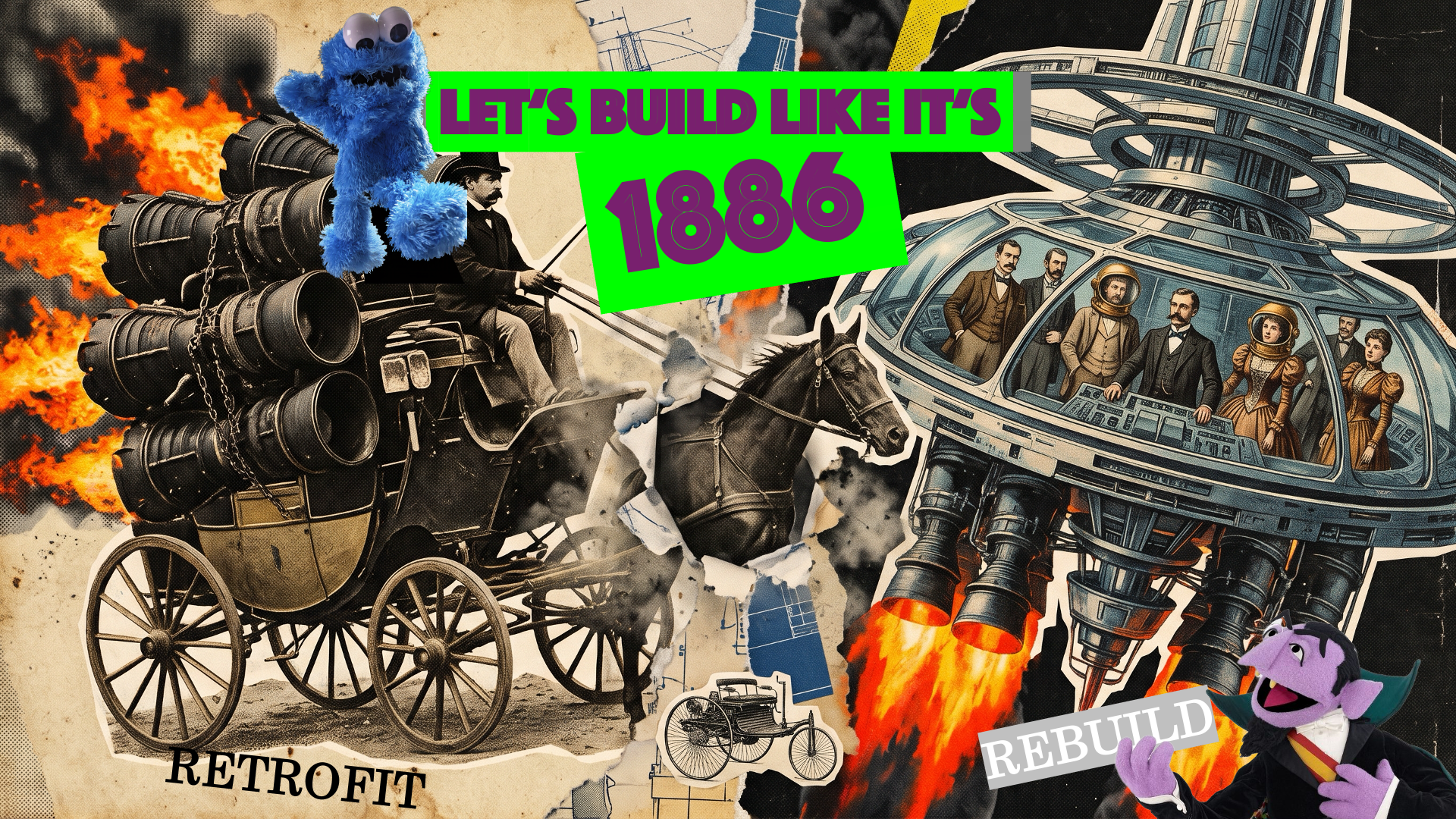
In 1886 engineers in Germany designed a vehicle around a new engine and for a human driver. That skill is needed again, with a different engine. Let's use it.
Courage '26 is the annual gathering of encourageventures, the network of women investors backing women founders. On 11 November, people from across Europe who start and fund companies came together to talk about innovation and impact. For the first time the event took place in the Mercedes-Benz Museum in Stuttgart, in the same building as two vehicles from 1886.
Today those vehicles look like the safe beginning of a success story. For the people who built them, nothing about it was safe. Daimler and Benz were founders. There was a new engine and no template. There were hardly any buyers and plenty of doubters, and even Carl Benz had less faith in his invention than his wife did. They built anyway. Our "AI meets Impact" session was about the same task, with a different engine.
Gottlieb Daimler fitted his engine into a horse carriage. Carl Benz designed frame, wheels and drive around the engine, with a seat, a tiller and a brake for the person driving. This is no story to rest on. It is a description of a skill: taking a new engine and designing the whole system around it and around the person who operates it. Today the engine is data plus probability machines, and most organisations place it into existing processes. The challenge is not to bring AI into today's organisation. It is to design the organisation that becomes possible with AI.
At a Glance
- 1886 is a working method, not a heritage: design the system around the new engine and for the person who steers it, checks it and answers for it.
- Access to capable models is increasingly a commodity. The ability to make them work reliably inside an organisation is not.
- AI creates value when the organisation around it is redesigned: how work gets done, how decisions are made, how responsibility is exercised. That is a question of architecture, not of starting from zero.
- Once AI acts in a process, human judgement, evaluation and accountability are design requirements: steering, instruments, brakes.
- Bertha Benz shows what redesign requires in practice: experimentation in real operation, and the people doing the work shaping the design.
1886: Adaptation and Integrated Design
In March 1886 Daimler ordered an ordinary carriage from the Stuttgart coachbuilder Wilhelm Wimpff & Sohn and fitted it with his engine. The engine was new. The vehicle was not.
Benz had filed patent DRP 37435 on 29 January of the same year: three wheels, a tubular steel frame, the engine at the rear, all designed as one unit.
Both men shaped the automobile, and Daimler's company went on to build purpose-designed cars. The first Mercedes of 1901 was conceived as an automobile from the ground up. The two vehicles of 1886 still mark the difference between adapting an engine and designing around it.
Daimler's carriage is where most AI initiatives start: a new engine in an existing structure. Benz's car is the redesign: an integrated system around a new capability.
Today's Engine: Data and Probability Machines
A large language model generates its output from learned probabilities. The result is plausible, which is no guarantee that it is correct, and the same input can lead to different outputs. Prediction has become cheap, as I described in The Economics of Prediction Machines. The data from an organisation's own operation is the part nobody else has.
Traditional software can be tested against predefined rules. A probabilistic system also needs its quality measured continuously and controlled in operation.
Build Around the Engine
Once AI takes over work steps and prepares decisions, roles and responsibility shift. A process designed for people using tools is not automatically suited to machines doing part of the work.
Take an insurance claim. Putting AI into the existing process gives the employee a summary of the documents. Designing the process around AI means evidence is collected, completeness is checked, an assessment is prepared and uncertain cases are routed to the people qualified to decide. Roles, decisions and controls change together. The value comes from redesigning the work, not from generating the summary.
Why should anyone expect the full productivity gains of AI while still driving horse carriages with retrofitted engines?
Industrial history has seen this before: electrification brought its greatest productivity gains once factories were redesigned around electric power, not when electric motors merely replaced steam engines.
None of this requires a greenfield. What has to change is the layout of the work.
Build for the Human Driver
The Patent Motor Car had a seat, a tiller and a brake lever from the first drawing. Two years later it still lacked proof: it had only been driven over short distances.
In August 1888 Bertha Benz, whose dowry had helped finance the development, took the car without telling her husband and drove it a good 100 kilometres from Mannheim to Pforzheim with her two sons. The brake blocks wore down, so she had a cobbler fit them with leather. The hills were too steep, so she asked for a lower gear. Both went into the following models.
The journey shows what redesign requires in practice.
Redesign Requires Real-World Experimentation
The step that mattered in 1888 was taken on the road, without permission and without a guarantee that the car would arrive. The lesson for organisations is the road, not the missing permission: a redesigned process proves itself early, in real operation, with real cases and clear guardrails. A system that never leaves the workshop proves nothing.
The People Doing the Work Must Shape the Design
The patent carries one name. The record suggests more than one pair of hands. Bertha Benz financed the work, spent evenings winding ignition coils, repaired the car herself on the road and came back with the idea for the lower gear, which Carl Benz then built in. He later said of her: "She was more daring than me." Whether history should call her co-engineer is open. That her view changed the design is documented. Organisations redesigning for AI need the same: the people who do the work, with other backgrounds and other questions than the builders, in the driver's seat and with a say in the design.
Human Authority: Steering, Instruments, Brakes
With a probabilistic engine, the driver's role becomes a design requirement. Three things belong in the construction from the start:
- Steering. People who understand both the business process and the behaviour of the model decide what the system does and within which limits.
- Instruments. Evaluation is the instrument panel: own test cases, measured with every model or prompt change. Nobody has to read every output, but somebody has to see where the system fails.
- Brakes. Somebody can stop the system, override it or swap the model, and somebody is accountable for the result. If that stays open, accountability lands on whoever touched the output last.
For Decision-Makers, This Means
First: Ask the Founding Question Before Choosing Tools
When I work with organisations on their AI strategy, I start with one question: how would this be built if the organisation were founded today, and who would be driving? Tool selection comes last.
Second: Redesign One Process, Next to the Existing
A unit with its own budget, in which domain experts and engineers work as one team, takes one process and redesigns it end to end. The existing operation keeps running while the new design proves itself.
Third: Keep the Ability to Operate In-House
Technology can be bought. Running, evaluating and exchanging models is a capability the organisation has to own, because it decides over cost, quality and data.
Sovereign is not whoever has the best AI. Sovereign is whoever can operate it themselves.
Let's Build
The vehicles of 1886 stand in a museum. The skill that produced them does not belong there.
The new engine is available. Building an organisation around it is the hard part. It means questioning how work is done, where decisions are made and who carries responsibility. It takes expertise in both technology and the business, leadership willing to change established structures, and the courage to prove new designs in real operation.
Carl Benz did not build a better carriage. Bertha Benz did not wait for the perfect automobile. They built, drove, learned and improved.
That is the task for organisations today. The technology is here. The organisation it makes possible still has to be built.
Courage '26 · "AI meets Impact" session · Mercedes-Benz Museum Stuttgart
Slides as PDFMotor carriage or new design: where do you want to take your organisation?
Let's talk