The Economics of Prediction Machines: Understanding AI as an Economic Factor
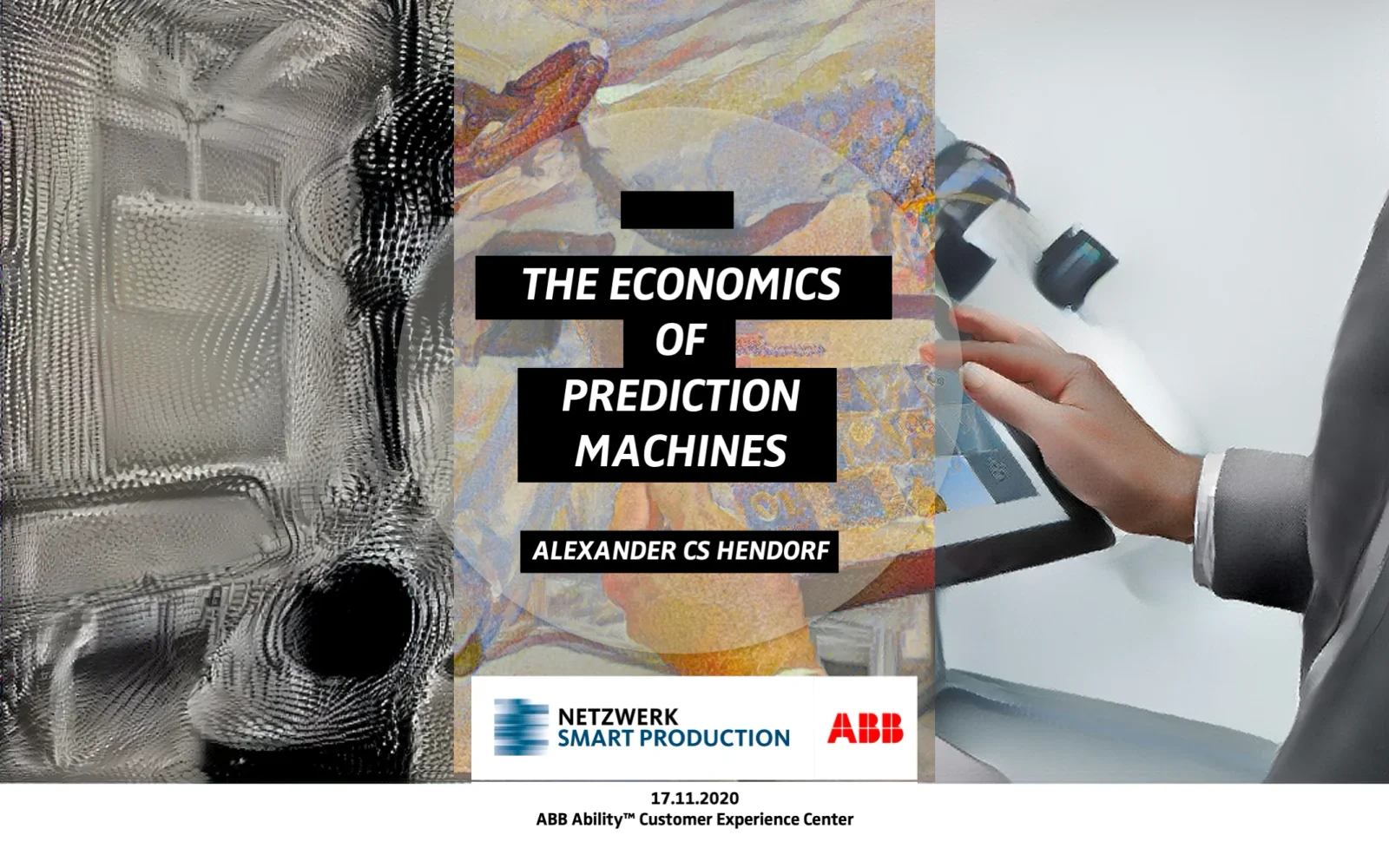
At a Glance
AI is not IT. It is research and development. That is the central insight my advisory work with German industrial companies keeps confirming. Companies that grasp how falling prediction costs change fundamental business models, and that build their prediction capacity systematically, will have a decisive competitive edge tomorrow. This article shows how the "prediction machines" economy actually works, and why strategy matters more than code.
AI is not IT, it is R&D!
This insight from my talk at the Netzwerkforum Smartproduction at the ABB Ability™ Customer Experience Center in 2020 has been confirmed in the years since by hundreds of conversations with boards and technology leaders. In practice I see the same pattern over and over: companies that treat AI as a technology project fail. Companies that grasp that this is about predictions (and therefore about economic disruption) create value systematically.
The Core: What Prediction Machines Really Are
The term "prediction machines" is more precise than the usual "AI" rhetoric. When I talk to industrial companies, I notice quickly that they understand all kinds of things by "AI": from robotics to chat systems. The reality is simpler and at the same time more powerful: AI systems are machines that make predictions. That is not marketing spin, that is the economics.
When falling prediction costs (driven by better hardware, cheaper data storage, open-source software, open research) become the new normal, completely new business opportunities emerge. That isn't science fiction. That is what I see happening in client projects every day.
And here is the first strategic gap: many companies don't think in predictions. They think in technologies. They think in IT projects. They don't think about how cheap predictions change their business model.
The Goldman Sachs Case: A Teaching Example
The much-cited Goldman Sachs example still captures pithily what happens when prediction costs fall. In 1999 the bank still needed about 600 traders to handle the US equity market. Today there are two. The rest is algorithms: prediction machines that continuously forecast market patterns and react automatically.
That is not just "automation". It is the reinvention of an entire business model. And I see exactly the same pattern in my client projects across Germany and Europe. In specialty chemicals, in mechanical engineering, in automotive supply. The companies that grasp fastest that their critical business processes depend on better predictions (rather than on better sensors or better machines) are the ones that win.
Where do I see this blindness most often? In two places: companies that haven't yet understood where their prediction costs could fall (which is most of them). And companies that think better predictions are an "IT procurement", instead of a strategic, iterative R&D task.
Where the Real Opportunities Sit: What I See in Industrial Companies
When I work with German and European industrial companies, I often hear: "We want to put AI into our machines." That is too narrow. The real potential is not in smart sensors but in predictions about what happens around them.
First category
Supply chain and demand planning. A mid-sized mechanical engineering firm I worked with had a classic problem: too much raw material in stock in good times, too little in bad. With better demand forecasts (not deep learning, but classical statistical methods) they were able to cut inventory by 22 percent and at the same time improve supply reliability. That is prediction machines in practice.
Second category
Unstructured information. Many companies have thousands of contracts, inspection reports and supplier correspondence. Modern natural language processing makes it possible to work with these systematically, not in order to automate completely, but in order to assess risks, find anomalies and detect compliance problems early.
Third category
Finance and risk. Better forecasts of cash flow, of supplier default risk, of fraud patterns in accounting.
What I keep seeing here: companies massively underestimate what is possible with simple, classical statistical methods. They want to start straight away with neural networks because they have heard that "deep learning" is fashionable. That is disorientation in the hype. The iterative path is: simple statistical methods first, then Bayesian methods, then (only if needed) the large models.
Why Most Companies Still Fail
The strategy gap is real. Companies see that "AI" matters. They start projects. But then they fail at the same point, because they have not understood that AI is not IT, it is R&D.
That is a fundamental difference. IT projects have clear requirements. You write a spec, commission a vendor, and they deliver a system that works or doesn't. R&D is different. In R&D, uncertainty is normal. Experiments fail. You have to iterate. That requires different governance, different budget models, different communication with the board.
I see again and again companies that budget three million euros for an "AI project", set up a large task force, and after six months realise the biggest blockers aren't technical but organisational. Data access is hard, because the data is spread across various legacy systems. The line of business doesn't understand why a model only has 75 percent accuracy. IT governance won't allow open-source software in production.
These are not technology problems. They are strategy problems. And they have to be solved by the board.
Best Practice: How It Works
From my experience with successfully implemented prediction machines in German companies, there is a proven pattern:
Phase 1: Definition (weeks 1-2)
Don't start with code. Start with the business question. Which predictions are truly critical for our business? Where do we already save money today through manual "predictions" (i.e. well-informed guesses)? Where do we lose money because our predictions are wrong?
Phase 2: Exploration (weeks 3-8)
Experiment with the data you have. Simple statistical methods. Quick prototypes. Two or three experts. Not 20 people in a task force. The insight "the model could deliver 18 percent better results, but we need more data" is more successful than a large project that fails because the requirements were never clarified.
Phase 3: Iteration (weeks 9-24)
The working model gets gradually integrated into real processes. This is the critical phase. Don't start at 100 percent accuracy. Start at "just better than the status quo". Real people use the system, give feedback. The model is continuously calibrated.
The take-off is not the goal. A safe landing is the goal.
Behind this sits a core principle: the take-off is not the goal. A safe landing is the goal. Many projects look beautiful at the demo stage and then fail miserably at production rollout. Success is not measured in accuracy scores but in: does it save real people time? Are business decisions actually better because of the better predictions?
The Strategic Opportunities
When prediction costs fall, opportunities open up that didn't exist before. Predictive maintenance (from reactive to proactive) is one example. Better inventory optimisation is another. Mass customisation (scaling personalised solutions) becomes economically viable when predictions about customer preferences become cheap.
But (and this is the most important observation from my projects) these opportunities don't appear automatically just because the technology gets cheaper. They appear when a company also anchors this new economics strategically. In other words: when the board doesn't only fund the technology but creates the organisational conditions in which R&D actually works.
That is foundations, not flailing. That is the differentiator. A company that starts with real strategy ("we want to be the prediction leader in our market, and that is a 3-5-year programme") will, in five years, beat competitors who today are starting AI projects faster.
The Central Question for Every Decision-Maker
Which predictions are critical for my business model? And: am I faster at making better predictions than my competition? That is the question. Not: "do we have a ChatGPT chatbot?" or "can we put sensors on our machines?"
The best prediction systems emerge when domain expertise and data-driven thinking come together. The chief data officer and the chief operating officer have to work together, not next to each other. The board has to understand that better predictions mean business models have to be rethought.
Summary: The Economics Have Shifted
The "prediction machines" economy is real. The falling cost of prediction is genuinely changing business models. This is not marketing. I see it in my projects every day.
But (and this is the point) not every company turns this opportunity into success at the same rate. The strategy gap is huge. Many boards don't understand that AI is not IT. Many technology leaders think it is about better algorithms, when it is actually about better data and faster iteration. Many companies are driven by hype rather than by real strategic thought.
That is disorientation in the classical sense. And it is also the opportunity for companies that stay sovereign.
The best predictions don't come from the most expensive models, but from:
1. Clear business questions instead of a tools-first mentality 2. Empirical, iterative processes instead of large waterfalls 3. Cross-functional teams that combine domain expertise with data competence 4. Real R&D budgets, not IT budgets 5. Strategy from the board, not from the technology team
The fact that this is so rare is exactly what will separate the strong companies from the weak ones tomorrow.
Do you treat prediction capacity as strategy, or as an IT purchase?
Let's talkThis article is based on my talk at the Netzwerkforum Smartproduction at the ABB Ability™ Customer Experience Center in 2020 and years of advisory experience introducing prediction machines in German and European mid-market and industrial companies.