Enterprise AI & Open Source: What Three Practitioners Said About a Sustainable Architecture
At a Glance
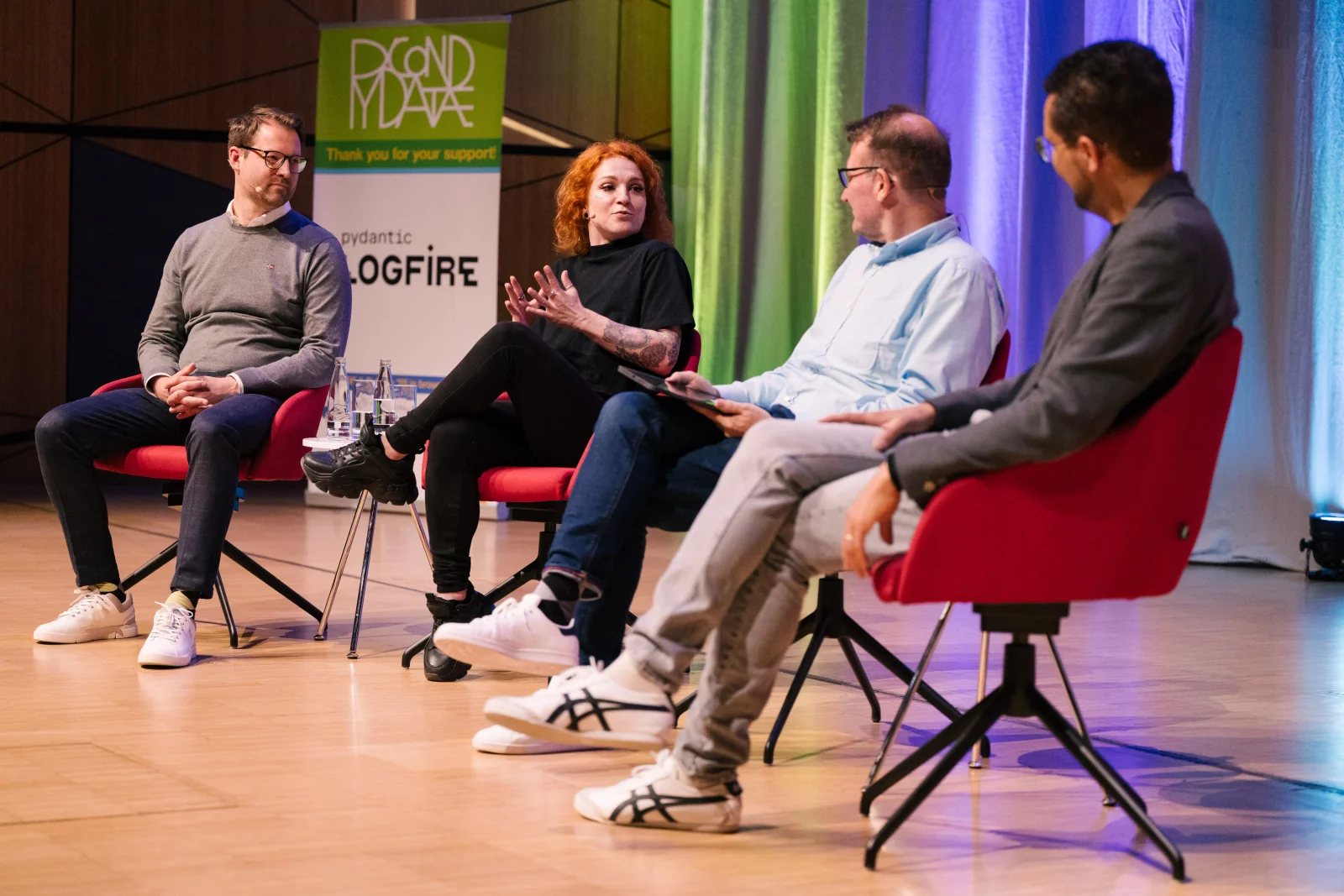
In the fireside chat "AI in Reality: Enterprise AI & Open-Source Innovation" at PyCon DE & PyData 2025, three practitioners sat on stage who work productively with AI in very different contexts: Walid Mehanna (Chief Data & AI Officer, Merck), Dr. Alexander Beck (six years CTO and Equity Partner at Quoniam Asset Management) and Ines Montani (Co-Founder and CEO, Explosion / spaCy). The discussion was not about hype but about what works in the engine room of large and small organisations, and what does not.
Four lines ran through the hour:
- In enterprise contexts in 2025, open source is the pragmatic default, not the idealistic exception. It lowers vendor dependency and accelerates innovation.
- Standardising on a single stack (Python) breaks down communication barriers between teams and accelerates delivery cycles, but costs friction at the start.
- The German and Nordic Mittelstand often moves faster than US corporates with a start-up coat of paint, because decision paths are flatter.
- Regulation isn't the actual problem; unclear regulation is. Anyone who doesn't know what "good enough" means builds paralysis instead of safety.
Merck: Pivoting as a Corporate Capability
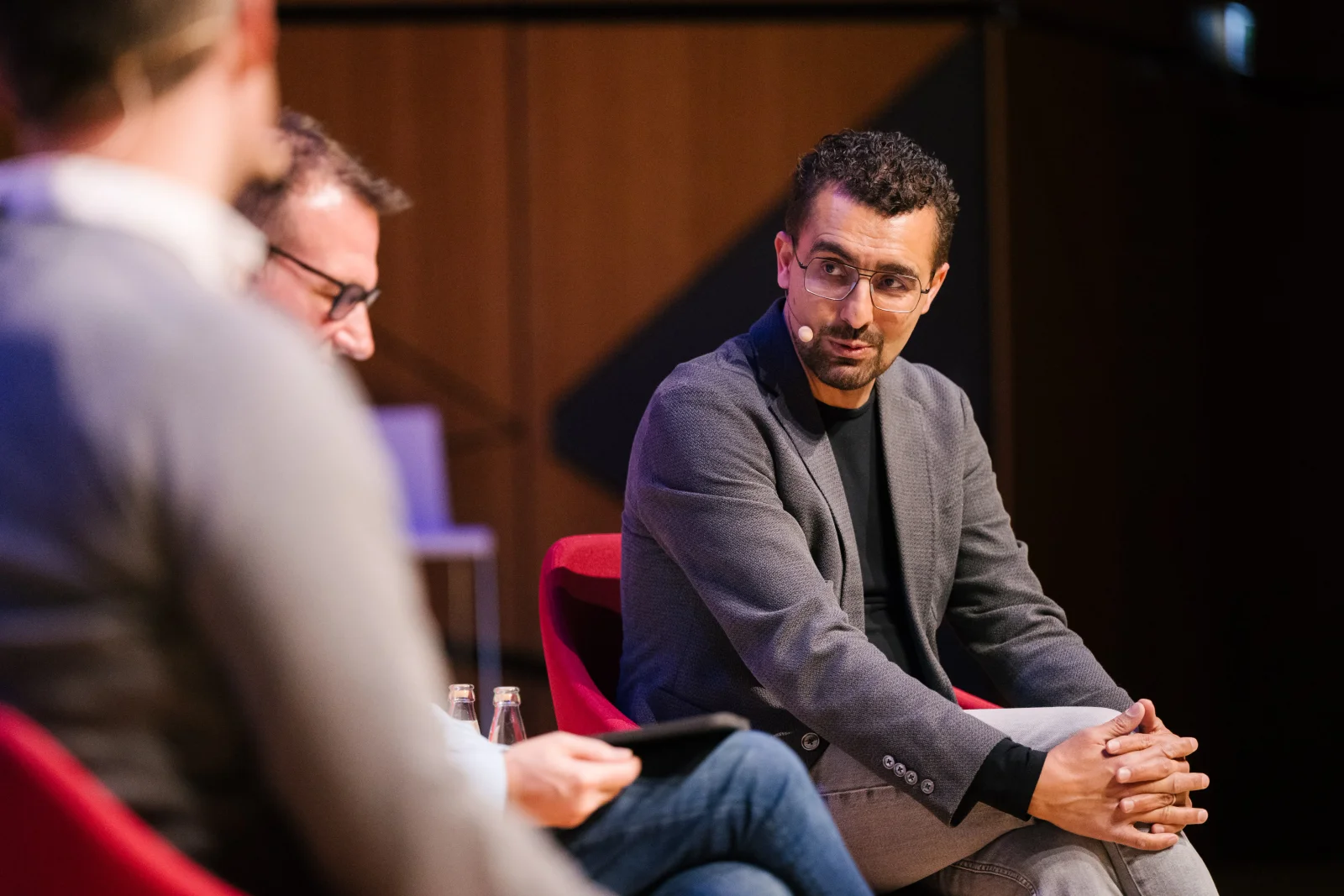
Walid Mehanna, Chief Data & AI Officer at Merck (a 357-year-old family business in its 13th generation, with 63,000 employees worldwide), described his organisation with a punchline that says a lot about the culture: "If Merck has one ability, it is pivoting." From pharmacy to pharmaceuticals to life sciences and electronics: change is part of the operating repertoire, not something that lives in the strategy workshop.
Mehanna's AI strategy rests on what he himself calls the "holy trinity": people first (mindset and skillset), ways of working (orchestration and integration across teams), technology (libraries and services). That sounds simple, but at 63,000 people it isn't.
His stated ambition: "My dream is that you don't need me anymore because 63,000 people in this company breathe data and AI, everybody knows what it is, when it's useful, when it's not useful and can apply it." That is not marketing, it is an ecosystem approach: security, compliance and cost efficiency combined with broad-based education, from low-code tools for domain experts to full-stack development inside the engineering teams.
Notable was Mehanna's stance on coding standards: "freedom in a frame". As long as work is properly documented and run-time costs don't explode, he has no interest in monolithic mandates. He expects modern, AI-assisted IDEs to converge consistency and quality on their own.
Two Mehanna stories illustrated his pragmatism. First, the MyGPT episode: when ChatGPT went public, he wanted to follow suit. His team drily informed him that the NDA had been signed nine months earlier. Six months later, an in-house version was running on Microsoft Cognitive Services. Later, the team decided to retire its own product in favour of a partnership with the Berlin start-up LangDoc. Mehanna's reasoning, in his own words: "They have four developers and they're a startup. They're working day and night. They don't have family. ... They will overtake us in three to six months. So why not join forces now?" That is lived pivot culture, even against your own code.
Second, the sandbox logic: in a global group, there is always a jurisdiction in which an experiment is regulatorily viable. "But in essence, it's piloting in a sandbox", Mehanna summed up. What proves itself there then scales, with clarity about the risks, into other markets.
Quoniam: Standardisation as Cultural Revolution
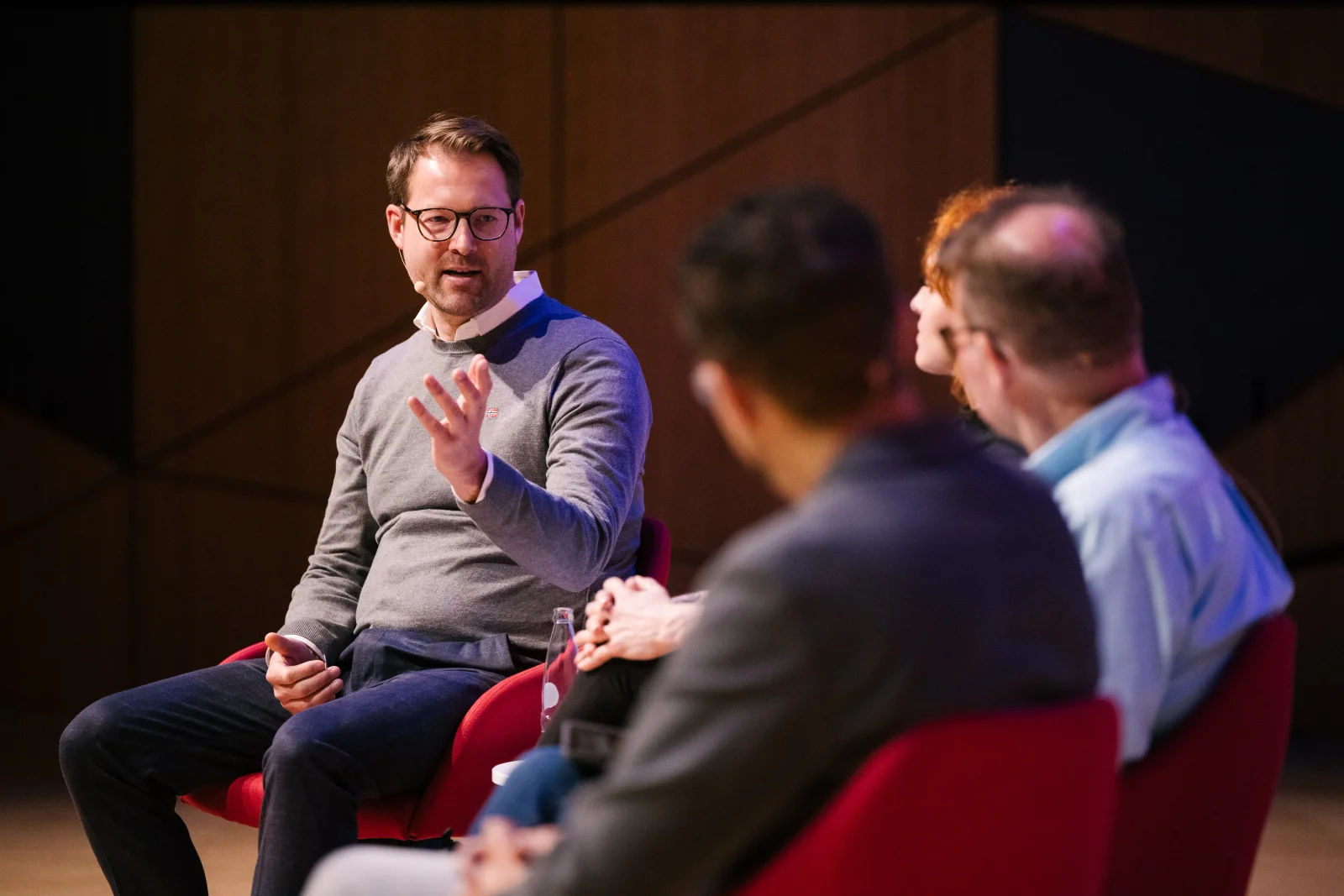
Dr. Alexander Beck spent six years as CTO and Equity Partner at Quoniam Asset Management, a quantitative asset manager with more than €24 bn assets under management, part of the Union Investment Group. He described the migration of a fragmented stack: "Back then we had SAS, R, C Sharp, a little bit of Python, a lot of SQL. And we harmonized this into Python." In a regulated financial context (BAIT, DORA), this was not a small decision.
The effect was measurable. Where application development had previously run in C# and search in R, Beck described the prior state plainly: "The two teams couldn't talk to each other. They couldn't learn from each other. They couldn't share code." Today research and application development work on the same code. Domain experts understand what the engineering teams are building, instead of having to delegate it.
Beck's honest assessment: "The first steps everyone has to realign a little bit their way of working, that causes friction. ... But once you are behind these initial fires, you really feel how this harmonization speeds you up and makes you better." Standardisation is not sexy, it works. Asked about the best decision of his time as CTO, Beck answered without hesitation: "This really goes back to 2020, where we said for the whole company: We are a Python company."
Beck added two further operational points. First, the reality-check number: at around 100 employees, Quoniam has "at least five very good use cases ... maybe ten more in the pipeline that have potential". That is an order of magnitude that is more honest than boardroom slides with three-digit use-case lists. Second, the LLM sandbox architecture: APIs to Azure OpenAI inside a contractually secured frame: the "safe haven" in which productive use cases can emerge without leaving the regulatory perimeter.
Explosion / spaCy: Open Source as Business Model, and the Mittelstand Punchline
Ines Montani, Co-Founder and CEO of Explosion and core developer of spaCy, brought the perspective of the open-source vendor into the panel. Her business model is counter-intuitive: if the spaCy documentation were worse, no one would use spaCy; if it were too good, there would be no consulting business. Explosion does not earn money by explaining how to use spaCy to teams, it earns money on workflows and on building proprietary models in-house. Montani described the truly hard work like this: "How to take a business problem and break that down into components that you can solve with machine learning."
One of her most important admonitions, the kind that lands in any boardroom discussion: "This is not a competition. You're allowed to make problems easier."
Montani's most valuable observation, and a corrective to the usual picture of US innovation versus German inertia: the most agile early adopters were not US start-ups. "Even Mittelstand companies in the Nordics, they have, you know, sort of a slightly different mentality. We saw those first before we saw the German companies." The reason is not regulation or hype culture; it is flat decision paths.
The counter-punchline is an anecdote that lands instantly in board conversations. Montani described US corporates "that operate more like startups and pride themselves on like how they've disrupted whatever", and fail on a $2,000 licence. In the original: "They were unable to buy a license from us because ... spent weeks in legal and eventually failed for ... something that cost a few thousand euros, they were unable to purchase it because we refuse to just change the jurisdiction of our contract for a purchase of $2,000." That is the actual vendor-lock-in effect: not in the tool but in the procurement and legal architecture.
Montani was equally clear about prestige projects: "Some companies actually want prestige projects, and they usually fail. It's like, oh, let's just do a chatbot. And that never makes it out of the prototype phase." Successful, she said, are the teams that recognise the truly hard work isn't model training but the question of how to break a business problem into solvable components. A second, similarly tidy line: "We've learned outsourcing development never really worked. We learned that in the 90s. Outsourcing data development, annotation. We've also realized that doesn't work." In-house development with domain experts at the table is the recurring success formula.
The Regulation Paradox
Beck and Montani converged on a diagnosis that is central for regulated industries. Beck, from the financial-sector perspective: "In Europe there is too much weight on regulating things." The problem is not regulation itself but its lack of definition: "When the regulator itself cannot really tell you what they expect, you're kind of left alone on high sea, and at some point in the future, somebody may or may not come and tell you, oh, all what you did is wrong." The consequence: more paper, less value.
Montani brought the counterpoint that often goes missing: "We need to understand the technology in order to regulate it well." That is the second half of the diagnosis. Anyone who is responsible for code reviews without being able to read code creates exactly the paralysis Beck describes.
Mehanna added from the corporate perspective: the talent base in Germany and Europe is solid, the industrial application fields abundant. What is missing is scaling mechanics. Start-ups that want to grow are often told they have to go to the US to find growth and customers. Mehanna's reading: "We can learn from the US, we can learn from China, but we have to find our own way."
Make or Buy, and What Standards Cost Today
On the question of coding guidelines, all three agreed: 2025 looks different from four years ago. Where long rulebooks used to be written, the answer today is simply: "Let's use UV, let's use Ruff." Great open-source projects have built great standards that are easy to follow. Hours that used to flow into style debates are freed up for substance. Beck added that code reviews and vulnerability scans are of course still part of the process: standards do not replace discipline, they make it easier to enforce.
For Mehanna, the make-or-buy question wasn't a matter of belief. "Our strategy is find the best solution that works for the company ... and scale it in a global environment." On selection: "If it's open source, great. That is always our preferred go-to when there is something that is enterprise ready." If not, look for partners: "partners can be big or small. If they're small, even better, because we can offer them more". The other side, large multinationals like Merck itself, "only want our money and our brand to a certain degree".
Beyond Hype
To close, a question that is rarely answered honestly: which technology, beyond the noise, should you really be watching?
Mehanna placed his bet on the integration of hardware and software: "I still believe there is a beautiful competitive advantage in merging hardware and software. ... Apple has played very nicely. More and more companies like Groq in the inference space ... Doing an integrated view is a heavy investment, but I believe it's also a high risk, high opportunity play. I would love to see a European player doing this." This is not academic geopolitics, it is the answer to where inference cost advantages will come from in five years.
Montani put the product lever centre stage with an image that sticks. In the past, she said, people used to wake others up by knocking on windows. "We didn't build window-knocking machines. We built alarm clocks." The point for AI investments: anyone who replaces human tasks one-for-one is thinking too small. The valuable innovations come from redefining the task itself.
Beck came at it from a third angle: in a world of growing geopolitical fragmentation, every European, and especially every German, offering deserves a close look. That is also a make-or-buy statement, just with a different sign.
A concrete Mittelstand example from Mehanna for the thesis "AI has long since arrived in German industry": Trumpf uses AI to optimise cutting layouts on sheet-metal machines and to reduce waste. No generative drama, simply a better optimisation layer over an old machine.
So What
Three lines from the fireside chat that show up again in every advisory discussion about regulated industries.
First: Standardisation
The unsexiest high-performance investment of the next five years. Quoniam's Python migration shows that the friction at the start is real, and the speed gain afterwards is equally real. Anyone who bets on hybrid stacks because "every team should be able to choose" is optimising for local comfort zones rather than for delivery capacity.
Second: Open Source
In 2025 the pragmatic default in enterprise contexts, not the idealistic exception. Merck's line, when an enterprise-grade option is available, then open; otherwise partner, smaller rather than larger, is the operational translation of that stance.
Third: The Mittelstand
More agile than the usual innovation narrative claims. The real brake is not German inertia but procurement and legal architecture, and that holds in the US at least as clearly as it does in Europe.
How sustainable is the foundation under your enterprise AI architecture?
Let's talkRelated links
Observations from the fireside chat "AI in Reality: Enterprise AI & Open-Source Innovation" at PyCon DE & PyData 2025. Panelists: Walid Mehanna (Merck), Dr. Alexander Beck (Quoniam Asset Management), Ines Montani (Explosion / spaCy). Moderation: Alexander C. S. Hendorf. All quotations are original wording from the fireside chat (English); the connecting text is the author's.