Cross-Pollination & AI: Scaling in the Era of Autonomy
Conclusion: The Future Belongs to the Connected
In the era of autonomy it will not be the companies with the best single technology that win, but the ones with the best networking and the most effective knowledge exchange.
This is not a theoretical ideal. This is what I see live, having worked in the international data-science community for years. I see how a method from space research becomes the standard in finance three years later. I see how an open-source project a junior developer started on a Friday alongside their day job suddenly transforms an industry. I also see the opposite: companies that ignore all these chances because their silos are too deep, their mindset too outdated, their execution backlog too large.
Cross-pollination is not a luxury for innovative companies. It is a survival strategy. In a world where everything changes exponentially fast, the ability to learn from others and share your own knowledge is the decisive competitive advantage.
The technology will become ever more autonomous. But the human factor of networking will only become more important.
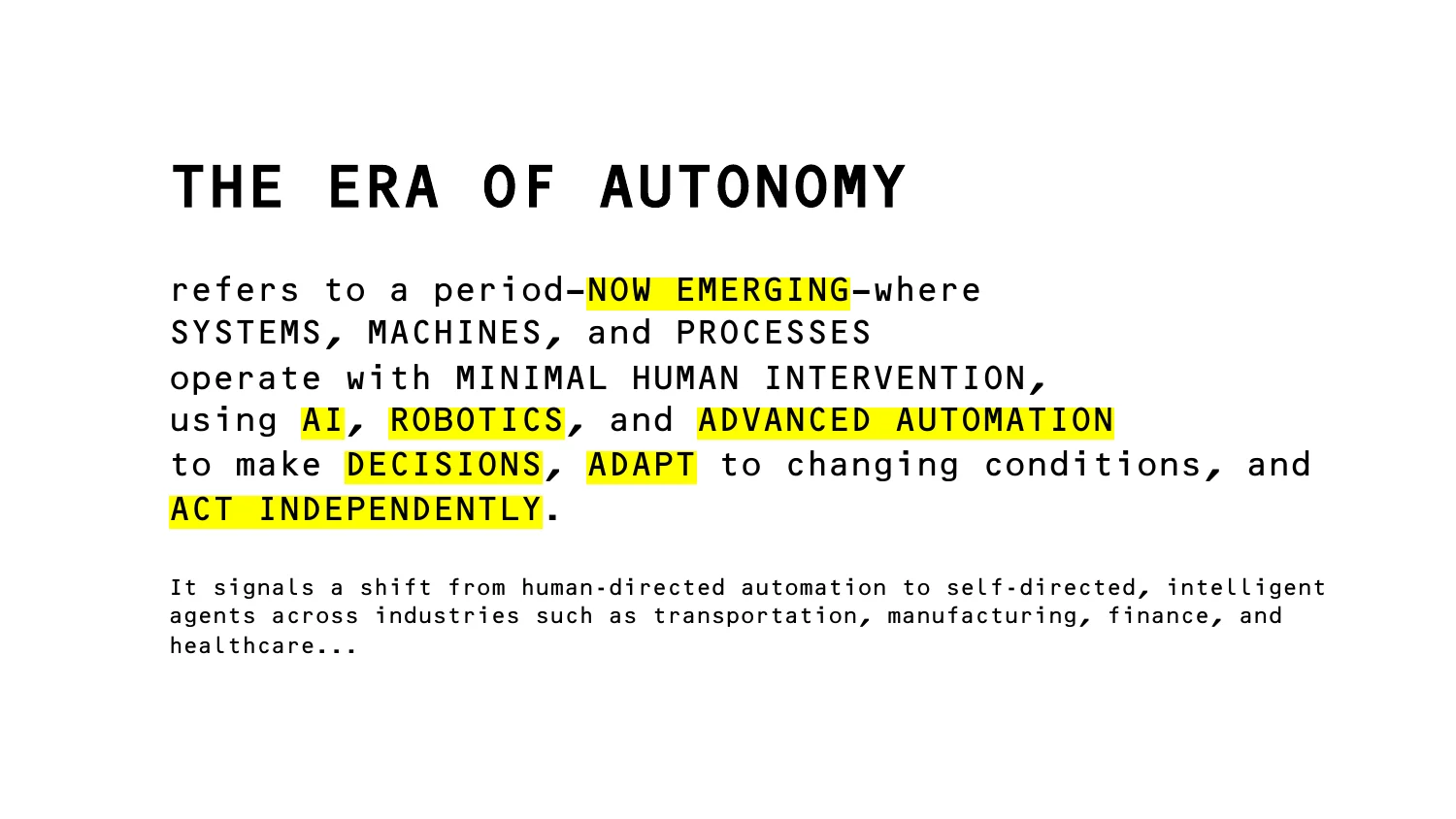
We are in a period of transition: the era of autonomy. Systems, machines and processes increasingly operate with minimal human intervention. They use AI, robotics and advanced automation to make decisions on their own, adapt to changing conditions and act independently.
But how do we scale successfully in this new era? The answer lies in a concept that is older than any technology: cross-pollination, interdisciplinary exchange of knowledge.
I have been able to watch this force play out for more than a decade, not in a classroom but where it counts: in the international Python and data science community. At conferences like PyCon and PyData I saw astrophysicists talking with fintech founders, industrial-automation engineers adapting algorithms from university researchers, open-source communities solving complex problems without any competitive instinct. That was never theory. That was the proof that real innovation happens at the seams.
At a Glance
The era of autonomy needs networking. AI systems get more powerful by the day, but the companies that win are not the ones with the best single technology. They are the ones with the best networking across boundaries. Cross-pollination is not optional. It is the difference between stagnation and leadership.
Three layers are necessary
- Structure: create the time and space for exchange. Tech talks, internal wikis, deliberately diverse teams. None of this is free, but it is invested, not spent.
- Culture: a culture of openness and curiosity cannot be decreed. It is built through continuous accompaniment, through example, through showing that cross-pollination is rewarded.
- Strategy: all of this needs leadership backing. It needs the clarity that breaking down silos is not just desirable but a question of competitive survival.
Where are silos blocking AI value in your organisation?
See the Boardroom-to-Code sessionWhat Is Cross-Pollination?
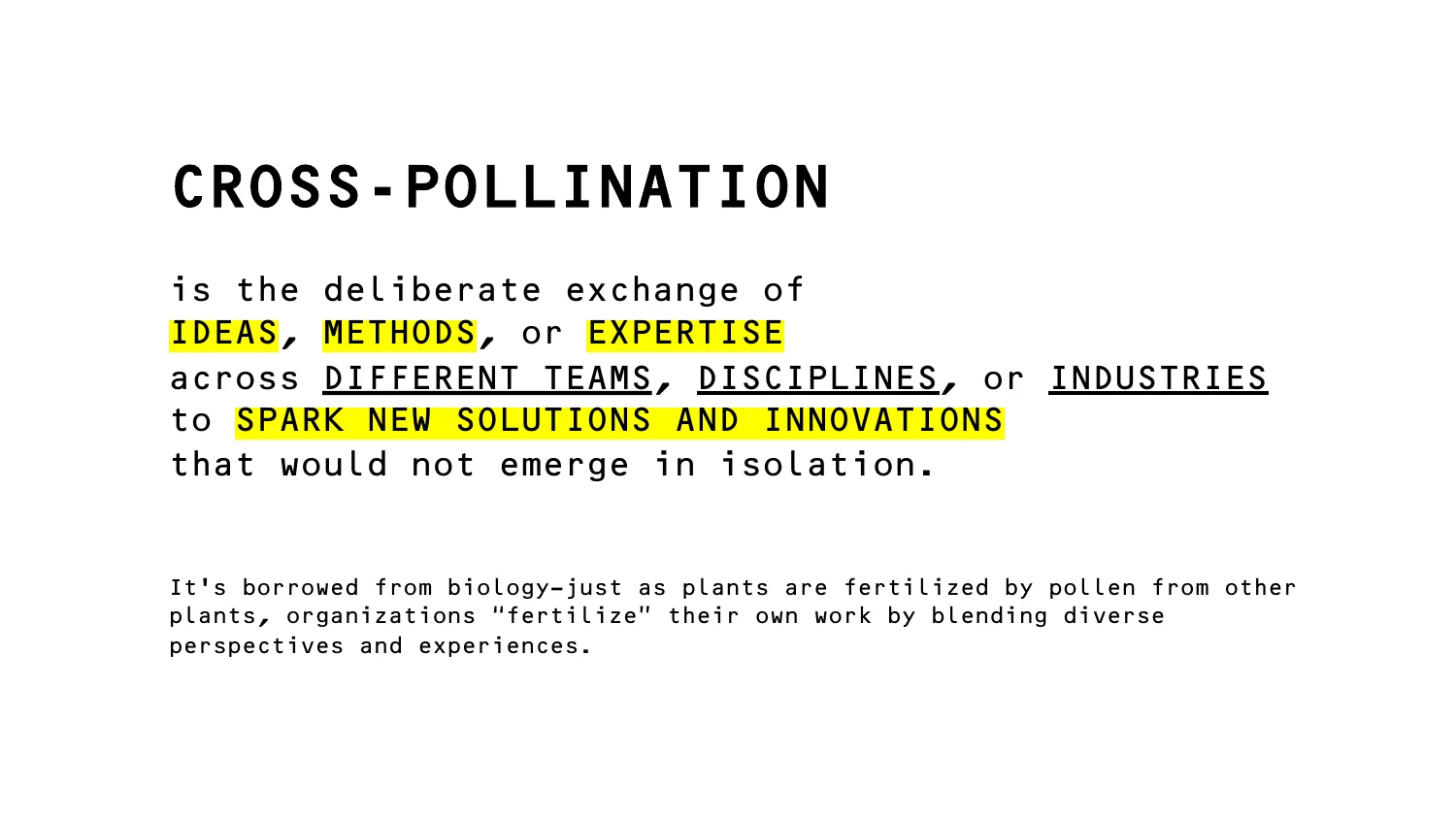
Cross-pollination describes the process by which ideas, methods and approaches travel between different fields, industries or disciplines. As with pollination in nature, these "crosses" often produce the most innovative and most resilient solutions.
This becomes especially clear in practice when you watch a large industrial group with a hundred subsidiaries and decentralised teams: when logistics develops a forecasting solution that can be reused in financial planning, in workforce planning and in supply-chain management, those teams save themselves months of development time. But only if the silos let them. Only if people actually know about each other.
Why Cross-Pollination Matters More Than Ever
In the era of autonomy we face unique challenges:
1. Accelerated innovation
Technologies develop exponentially fast. What works today can be obsolete tomorrow. Cross-pollination shortens innovation cycles, because solutions often already exist in other domains, we just have to find and adapt them.
2. Complex system integration
Autonomous systems have to interact seamlessly with people, with other machines, and with constantly shifting environments. That complexity cannot be handled by a single discipline alone.
3. Sovereignty and resilience
In a connected world, dependencies have become risks. By exchanging knowledge across domains we develop more robust, less brittle solutions.
Cross-Pollination in Practice: From the ESA to Finance and Beyond
One of the most striking examples of cross-pollination I have watched over the years starts at the European Space Agency (ESA). ESA scientists analyse gravitational waves and cosmic events with mathematical methods that are extremely specific and refined: pattern recognition over massive volumes of data, anomaly detection in signals, predictive models under uncertainty.
For a long time these algorithms were academic knowledge, until fintech developers discovered them. They recognised that the methods used to detect gravitational waves are almost identical to the early detection of fraudulent transactions. Both systems have to find true signals in noise. Both work with high data frequencies. Neither can afford false positives.
That triggered a wave of adoption: fintech companies built better fraud-detection systems. Then industrial companies (manufacturers, energy utilities, logistics) saw the same patterns and adapted them for predictive maintenance. Suddenly you could detect machine failures weeks in advance, simply by using mathematical tools originally developed for spaceflight.
This works so elegantly because three things hold this community together:
First, the shared language
Python is not just a programming language; it is a connecting code between space scientists, financial engineers and factory planners. When everyone writes in the same language, best practices become portable. An algorithm from space research is much easier to adapt if it is already implemented in Python.
Second, the culture of openness
In open-source communities, competitive instinct is out of place. When a researcher develops a breakthrough method, it goes up on GitHub and gets documented. It is not guarded as a corporate secret. That enables incredibly fast cross-pollination, because good ideas don't ossify in silos.
Third, the forced diversity around concrete problems
At academic conferences, people from completely different fields end up in the same room. An astrophysicist sits next to an e-commerce engineer. A university researcher next to a start-up founder. They don't talk in the abstract. They talk about real problems: "how do you detect anomalies in millions of measurement points per minute?" The answer turns out to be surprisingly industry-independent.
The Dimensions of Cross-Pollination: How Real Companies Benefit
Cross-pollination works on different layers, and I have learned that each one matters.
Horizontal cross-pollination
Happens inside the organisation, but only if it is structurally enabled. I have seen large companies in which the marketing department develops an AI solution for customer forecasting while logistics, completely independently, solves the same requirement. Both teams sit in the same building. Both have access to the same data sources. But there are no channels for exchange. The result: duplicated development, half the effectiveness. One company that recognised this introduced regular tech talks across departments: three times a week, 30 minutes, one developer presents something. The result was dramatic: suddenly teams realised they could share already-solved problems.
Vertical cross-pollination
Is the fusion of experience levels and academic knowledge with practical reality. A junior developer who has just read a recent paper on AI-supported resource optimisation runs into a senior who knows the company tried exactly this 10 years ago and it failed, because the data was too dirty. That combination is gold. And yet it happens too rarely, because hierarchies and time pressure get in the way.
Radical cross-pollination
Is where I see most of the success stories, when a company deliberately brings in someone with a completely foreign background. A music producer who knows acoustics solves an audio-processing problem differently from any classically trained engineer. A biologist sees evolutionary patterns a computer scientist misses. That is not exotic. That is the most common source of real innovation.
AI and Cross-Pollination: A Natural Symbiosis
Artificial intelligence and cross-pollination reinforce each other, but not automatically. It takes deliberate design.
AI as enabler for cross-pollination
I see companies building AI systems that automatically detect patterns between completely different data sources. A financial firm uses AI to spot that the patterns it sees in transaction data are structurally identical to biological patterns a researcher has published: suddenly ideas emerge for entirely new approaches. AI can bridge language barriers: a system that automatically translates research papers from astrophysics into practical questions for industry would accelerate cross-pollination exponentially. But that only works if the AI is actually trained on diverse sources.
Cross-pollination as AI success factor
Conversely, the best AI systems I know almost always emerged at the seams. Why? Because they benefit from diverse training data. A fraud-detection system trained only on financial data does not recognise new patterns. A system that also learns from ESA methods, from medical data, from anomaly detection in industry, that becomes more robust. The most creative applications emerge when teams from different worlds think together: "what if we used this AI method not for the original question but for something completely different?"
Practical Implementation in Companies: From Silos to Networking
I have seen these principles fail when they are not backed by real strategic support. That is also where many companies get stuck: they know they have to clear the execution backlog: projects take too long because departments work separately. They know that their outdated mindset hurts them in competition: teams are too in love with their silos. But they don't know how to proceed systematically.
Experience shows me three layers that have to work together:
First, the structure
That doesn't just mean saying "from now on we work cross-functionally." It means actually creating the time and space for exchange. One company I worked with set up regular tech talks: short, practical, mandatory for tech leads. In parallel they built an internal wiki where solutions were documented so they could be reused. Internally, they connected their teams to external open-source communities, not as a "nice to have" but as a strategic objective. That was an AI & execution strategy: in 6-8 weeks we worked out together with the team how this networking would function inside the company's specific culture.
Second, the long-term accompaniment
Structure alone does not last. I have watched companies launch massive programmes, and after six months the energy was gone, the old silos had closed up again. That is where AI transformation accompaniment comes in. Not just the technology, but the processes, the trust between teams, the continuous calibration of the culture. That is a 6-24-month process. You don't build a real networking culture in 8 weeks. You build it continuously, with setbacks and adjustments.
Third, C-level backing
This cannot be delegated. If a CTO or board member does not say "cross-pollination is strategically essential to our survival in the age of AI", it does not work. That is also the point of C-level sparring: in regular sessions you clarify what the strategic blockers actually are: are they real technology limits, or are they organisational barriers? Where is it worth investing, and where is time being wasted right now?
The Future: Autonomous Systems Need Human Networking
Here is the paradox I see in my work every day: the more autonomous the systems become, the more critical human networking becomes. AI systems can write code, find bugs, detect anomalies. But they cannot see what an astrophysicist and a financial engineer see when they think together: "which problem haven't we solved yet because we haven't thought across the lines?"
Humans remain irreplaceable because they understand context: the nuances, the history, the cultural differences, why an approach works in one company and not in another. Humans create creative connections that AI does not invent but at best recognises once they have already been articulated. And cross-pollination lives off trust and real relationships, off the fact that someone shares their knowledge because they know it won't be used against them.
Technology can amplify all of this. Tools for global knowledge exchange can lower barriers. AI can help bring relevant expertise together: "we have a problem in this area, and there is someone three departments away who has already solved exactly that". Better tools for documentation and sharing accelerate the process. But the essence (the willingness to learn from each other) has to come from people.
Slides